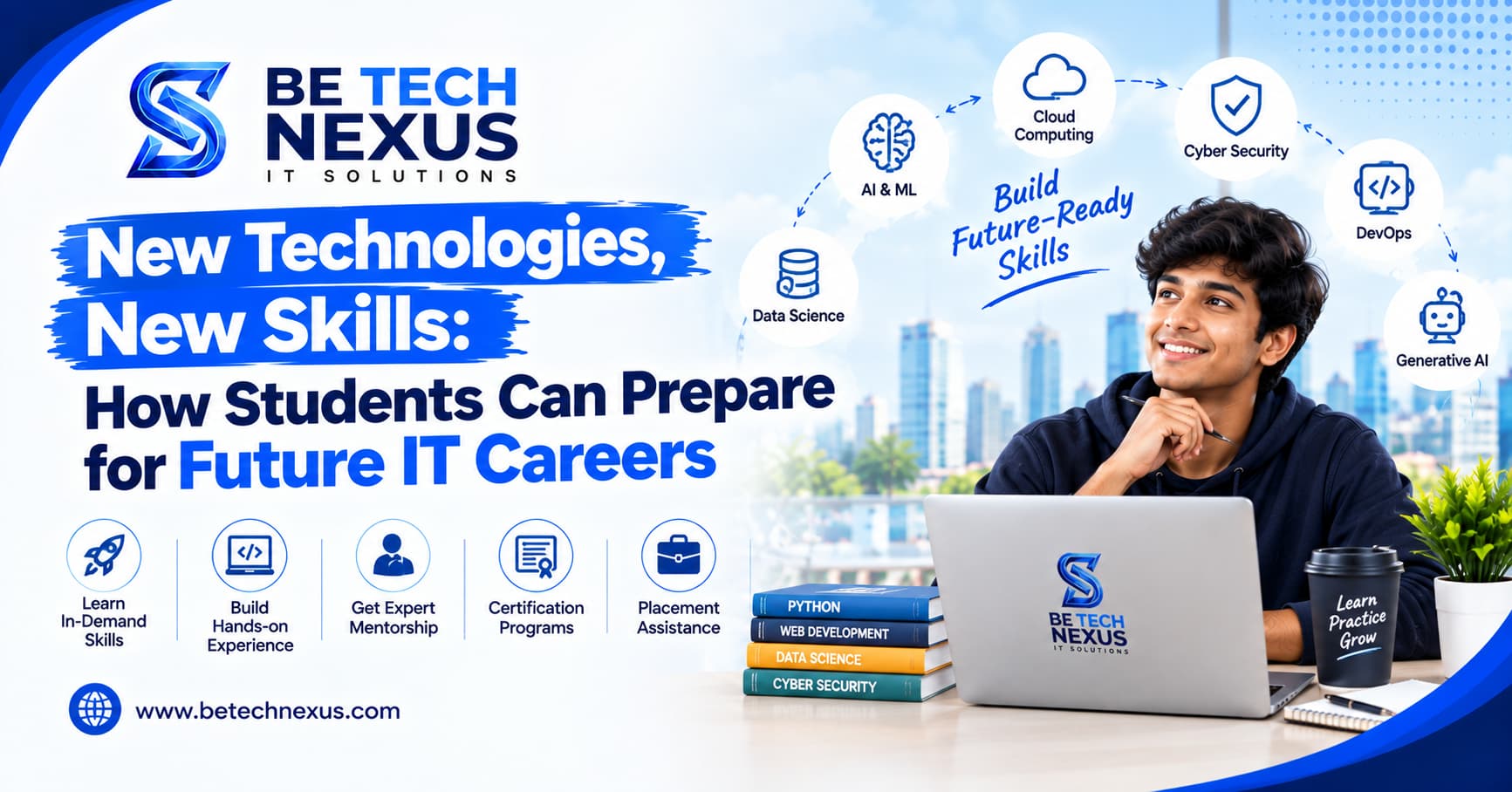
New Technologies, New Skills: How Students Can Prepare for Future IT Careers
New Technologies, New Skills: How Students Can Prepare for Future IT Careers
Technology is developing at an unprecedented rate; a skill that was extremely useful just a couple of years before can now be combined with more advanced technology, platforms, or tools. Many new technologies, such as artificial intelligence, cloud computing, cybersecurity, automation, data science, etc., create new opportunities in the information technology industry.
Having learned about this new reality, students aiming to work in the field of technology might feel a mixture of excitement and confusion about it. It is no longer enough to decide on a particular degree or study a single programming language, students need to know how technology is changing so that they will be able to obtain relevant competencies.
IT Learning Is Expanding Beyond Traditional Courses
In the past, students used to emphasize on the acquisition of knowledge of programming languages, databases, or basic software development. Although the goals mentioned above remain relevant, modern IT jobs require the combination of various technologies.
As an example, a software developer can apply programming skills together with cloud technologies, AI-based development tools, APIs, databases, and automation. Likewise, a cybersecurity specialist can learn factors related to cloud security and AI-driven threats next to standard security issues.
Nonetheless, it does not imply the necessity for students to know all the technologies. Instead, learners shall understand the interrelation of different competencies and choose the area they want to develop in.
Start With Strong Fundamentals
Even if it is new technologies that get the most notice, it is still true that solid fundamentals matter.
The student wishing to work in software development must first learn programming logic, solving problems, data structures, and application development. Knowing these concepts makes it much easier to learn younger frameworks or development technology based on AI.
Take two students that study some AI development technology. The first student knows programming concepts, while the second one has only learned how to use this technology through tutorials. The first student is more likely to understand how things work, identify mistakes, and adapt.
This is why choosing the best IT training institute in Hyderabad should involve looking at the quality of fundamentals being taught, not simply the number of technologies listed in a course brochure.
Learn Through Projects, Not Just Classes
One of the most effective ways students can prepare for their future careers is by applying the knowledge they have gained.
Instead of simply completing a course and quickly moving on to the next one, students should be completing mini projects. A student learning about Python can create an expense tracker or a simple automated solution. Another student who is learning web development can build a website for a local business. A student learning about AI can create a simple application where an AI model solves some real-life problem.
Doing projects gives students valuable practical experience that cannot be gained from textbooks or lectures alone. Projects also serve as concrete examples to talk about during job-interviews.
For instance, in an interview when a student is asked how he or she has used Python, saying “I completed a course on Python” is not that informative. Talking about how the student has used Python while working on a project would provide a much better understanding of the skill.
Develop Skills That Work Together
The future of IT is increasingly interconnected. Students can benefit from developing complementary skills instead of treating every technology as a separate subject.
A software developer could combine programming with cloud computing. A data professional could add AI and machine learning skills. A cybersecurity learner could explore cloud security and automation. Someone interested in application development could learn how AI tools can support development and testing.
Choosing the best IT training institute in Hyderabad can make this process easier when the learning approach connects technical concepts with practical industry applications.
The goal should be to become someone who can solve problems using technology, rather than someone who simply knows the names of many technologies.
Stay Curious About New Technology
Students are not required to master every new technology introduced. Instead, they must cultivate understanding of what is new.
For instance, when generative artificial intelligence became popular, it made its way to software development, marketing, customer service, data analysis, and many other industries. Those students who realized its utility at an early time took advantage of it to improve their own skills.
Keeping track of technological news, participating in webinars, trying out new instruments, and working on personal projects can help students stay informed about technology without being burdened by it.
Continuous learning plays an increasingly important role in the career of an IT professional. Knowledge a student obtained today can become outdated tomorrow.
Prepare for Skills, Not Just Job Titles
Many students tend to look for just one specific position and focus on mastering only the skills outlined in the single job description. A more useful strategy is to understand the general skills related to a career.
For example, a person aspiring to become a cloud professional has to master various aspects of networking, operating systems, cloud platforms, security, and deployment. A student interested in AI should have basic knowledge of programming, mathematics, data, machine learning concepts, and practical AI tools.
Such a degree of preparation allows students to adapt to changing environments and workplaces.
A best IT training institute in Hyderabad should therefore help students understand not only what to learn but also how those skills are applied in professional environments.
Build a Learning Mindset for the Future
Technology is continuously evolving and there is no one method for preparing people for future advancements. However, what the student can learn in this regard is to acquire how to learn, experiment, solve problems, and adapt to changes.
Those who will prosper in the future may not be the ones who use the most sophisticated technology. They might instead be the ones who knew the basics, gained experience, became proactive learners, and adapted to changes in the industry.
If a student wants to learn tech skills that are relevant in the future through practical training and mentoring, BeTech Nexus is a good opportunity to master the craft.
FAQs
1. Why are new skills important for students planning an IT career?
The IT industry is constantly evolving, with technologies such as AI, cloud computing, automation, and cybersecurity creating new roles and changing existing ones.
2. Should students learn every new technology they hear about?
No. Students should build strong fundamentals first and then choose technologies that align with their career goals and interests.
3. How can projects help students prepare for IT jobs?
Projects allow students to apply concepts to practical situations, develop problem-solving skills, and demonstrate their abilities during interviews.
4. Are traditional programming skills still important with the growth of AI?
Yes. Programming and problem-solving fundamentals remain valuable because they help students understand, build, troubleshoot, and adapt technology-based solutions.
5. How can students stay prepared for changes in the IT industry?
Students can follow technology trends, practice regularly, explore relevant tools, build projects, and develop a habit of continuous learning.


Comments (0)